← More projects

Senior project · Preliminary design · Cal Poly

Tidal Turbine Lift System

A tidal turbine platform sits about 10 meters below the surface. Our team developed a surface-operated buoyancy concept to bring it up for maintenance and lower it back to its operating depth.

My contributions: concept selection, preliminary buoyancy calculations, and work on the concept prototype.

Sponsored by Ian Bohannon of IM Bohannon Mechanical Design. This page covers the preliminary design and concept prototype; full-scale performance remains to be verified.

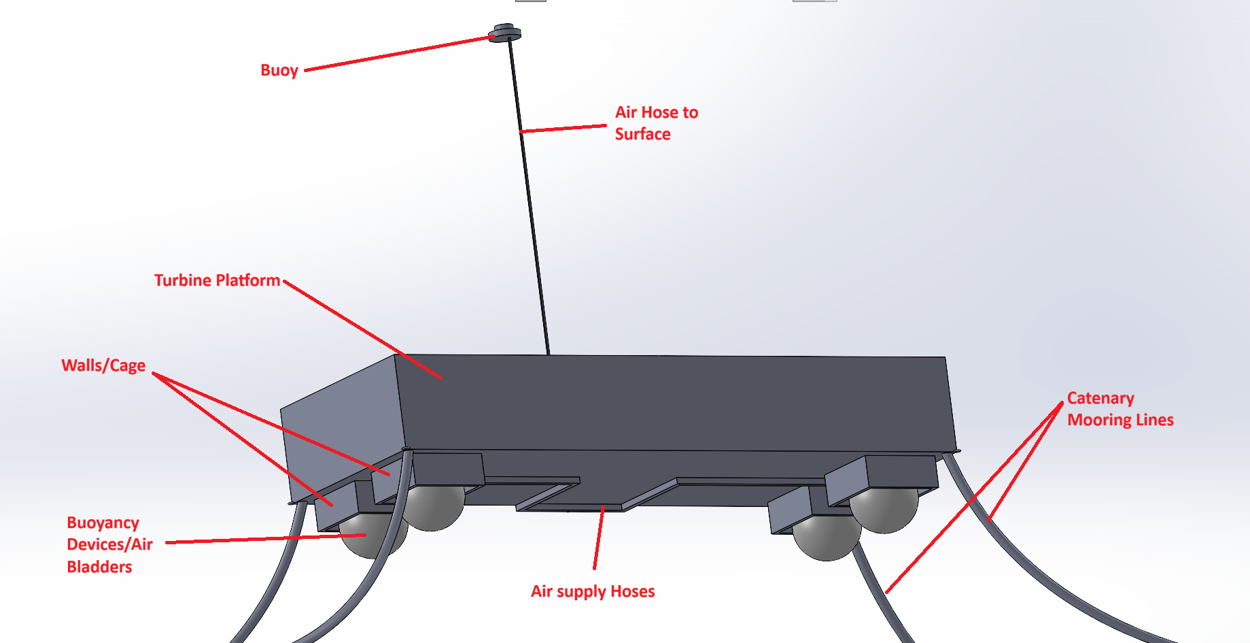
Labeled CAD concept showing the turbine platform, four air bladders, protective cages, surface air hose, and catenary mooring lines
Preliminary arrangement · team CAD image from the PDR report
~10 moperating depth
4 bladdersselected lift concept
7.15 m³preliminary submerged air volume

The design challenge

Make maintenance possible from the surface.

The submerged platform is held near its operating depth by catenary mooring chains. To service the turbine, the system must raise the platform, then return it to depth without requiring divers or a remotely operated vehicle.

  • Controlled travelTarget a raise and lower time of 15 minutes each, then hold the platform near 10 m ± 2 m.
  • Marine environmentAccount for currents, corrosion, biofouling, hose damage, and long service intervals.
  • Engineering deliverablesDevelop analysis, CAD and drawings, then build and test a small-scale prototype.
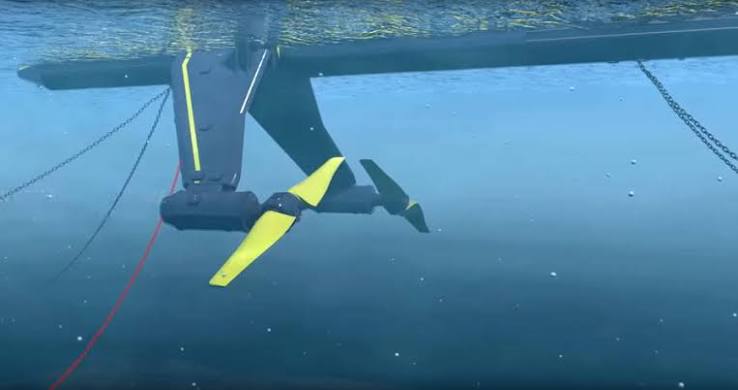
Underwater view of a submerged tidal turbine with a yellow and black rotor and mooring lines
Tidal turbine reference photo · first project image in the team's PDR presentation

Selected concept

Add buoyancy to lift the platform.

A technician would connect a compressor to a hose at the surface. Air flows through a manifold into four submerged bladders. As the bladders expand, they displace more water and lift the platform along with additional mooring chain. Venting air lets the platform settle back toward its operating depth.

Protective cages and isolated air branches are part of the preliminary design. Valve selection, bladder materials, and controlled deflation still need analysis and testing.

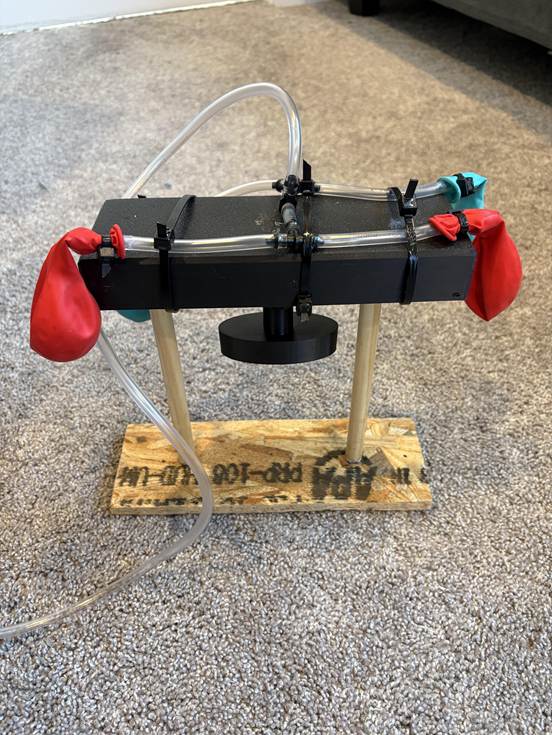
Small concept prototype with four balloons attached to a platform frame and connected by clear air tubing
Small-scale concept prototype · team photo from the PDR report

Concept selection

Why the team chose inflatable bladders

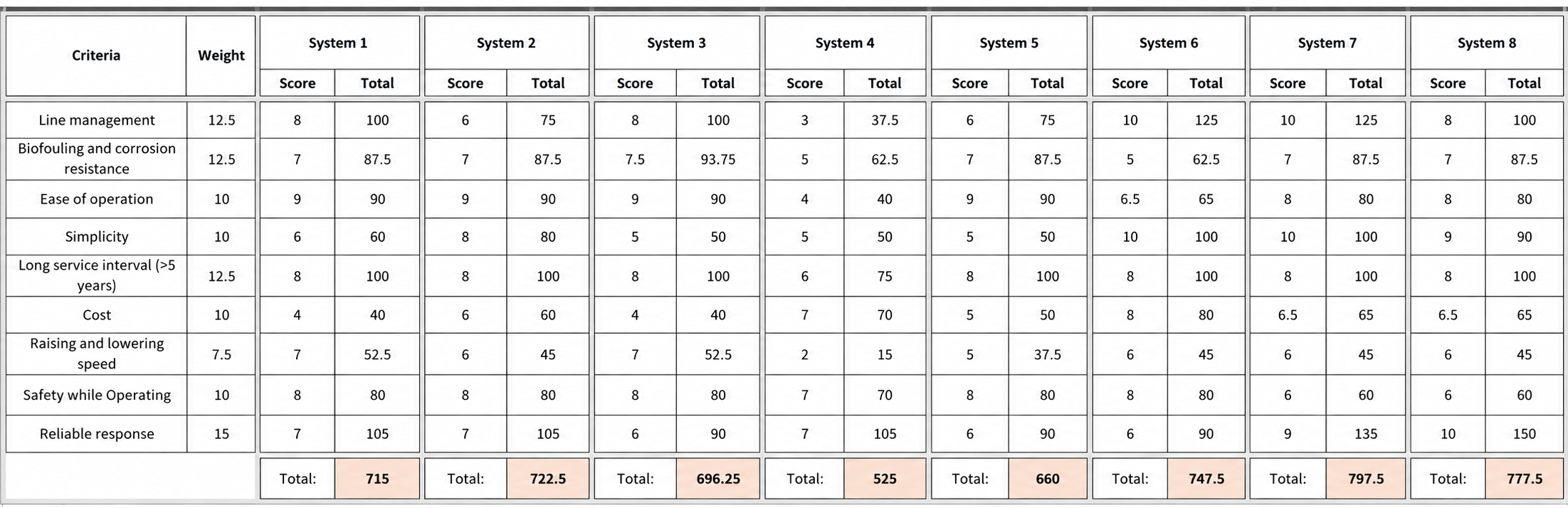
We compared winch systems, rigid ballast tanks, and inflatable bladder arrangements against criteria including line management, reliability, cost, operation, and exposure to marine growth. The selected inflatable system scored 797.5 in the weighted decision matrix, the highest of eight concepts. It removes submerged winch drums and cable-spooling mechanisms, while allowing separate bladder branches for potential fault isolation.

Weighted decision matrix comparing eight concepts; the selected inflatable bladder system has the highest total score of 797.5
Team weighted decision matrix · PDR report. Scores guided concept selection and are not performance test results.

Preliminary engineering analysis

The lift must carry more chain as it rises.

The platform's upward buoyancy is balanced by suspended chain at its operating depth. Raising it brings more chain off the seabed, increasing the load the bladders must support. The team's first calculation estimates about 72 kN of additional lift and at least 7.15 m³ of total submerged air volume. That estimate excludes bladder and cage weight and design margin.

Depth changes air volume

Near 10 m depth, air is under roughly twice the surface pressure. As the platform rises, the air expands and buoyant force changes. The next analysis will compare that expansion with the changing chain load throughout ascent.

Redundancy needs proof

Four independent bladders could limit air loss if one branch fails. The team still needs to show that the remaining three can lift the platform without unacceptable tilt or uneven mooring loads.

Concept prototype

A simple test revealed an air distribution problem.

In the small concept model, air transferred between connected balloons and they inflated unevenly. That observation led the team to consider individual pilot-operated check valves to isolate the bladders and a controlled way to vent them during descent. The model demonstrated an issue to solve; it did not validate full-scale lifting performance.

Next verification: test balanced inflation, controlled venting, valve reset, and operation with one bladder disabled in a scaled tank prototype.

Team project with Garrett Caltabellotta, Jonah Hulvershorn, Nick Glenn, and Kai Lambert. Sponsor: Ian Bohannon, IM Bohannon Mechanical Design. Images and technical figures are from the team's preliminary design review materials.
← Back to more projects